Waterproof-Breathable Fabrics

Waterproof-breathable fabrics revolutionized outdoor apparel, transforming garments from heavy, non-porous rubberized raincoats into comfortable, technical shells that keep you dry from both external precipitation and internal perspiration. Whether you are navigating a downpour during an alpine climb or hiking through heavy mist, understanding how these textiles function helps clarify why high-end gear performs differently across conditions.
A Brief History of Waterproof-Breathable Gear
For centuries, staying dry meant sacrificing comfort. Early rainwear relied on heavy, completely impermeable materials such as oiled canvas, rubberized cotton, and polyurethane (PU) coated fabrics. While these kept rain out effectively, they trapped body heat and sweat. With nowhere to escape, moisture condensed on the inside of the garment, leaving the wearer just as wet from perspiration as they would have been in the rain.
The turning point arrived in 1969 when Bob Gore—son of W.L. Gore & Associates founders Wilbert and Genevieve Gore—discovered expanded polytetrafluoroethylene (ePTFE) ; later patented and now commonly known as Gore-Tex. By rapidly stretching heated PTFE under precise conditions, Bob Gore created a microporous material consisting of roughly 70% air and a microscopic web of solid nodes interconnected by delicate fibrils.
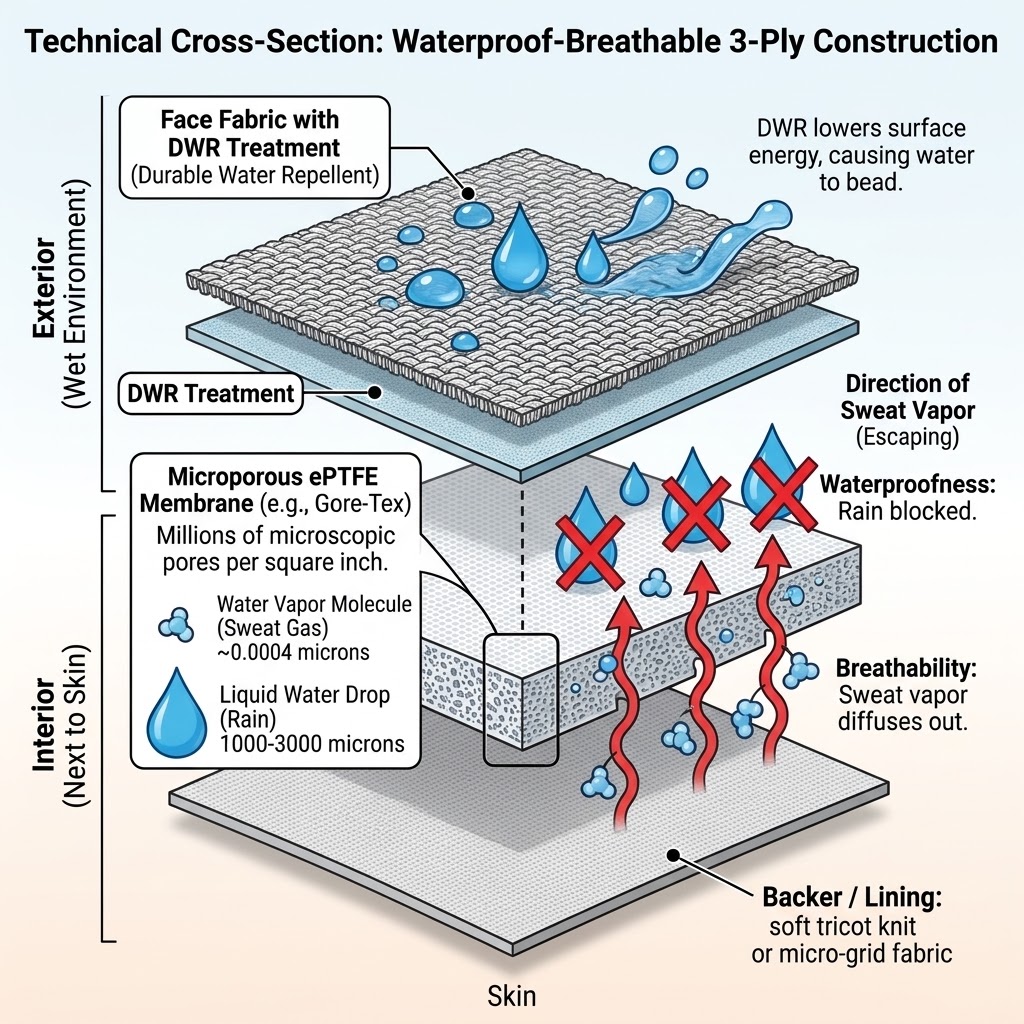
This ePTFE membrane featured millions of microscopic pores per square inch. Crucially, these pores were roughly 20,000 times smaller than a water droplet, preventing liquid rain from penetrating, yet roughly 700 times larger than a water vapor molecule, allowing body heat and sweat vapor to escape. Introduced commercially in the late 1970s, this technology established the modern paradigm of waterproof-breathable outerwear.
Over the decades, the industry expanded beyond ePTFE. Companies developed alternative microporous polymers, hydrophilic non-porous polyurethane monolithic membranes, and advanced chemical coatings, driving down production costs and improving environmental sustainability—notably through the industry-wide shift away from environmentally persistent Per- and Polyfluoroalkyl Substances (PFAS) toward PFC-free durable water repellent (DWR) treatments and alternative membrane chemistries.
How Waterproof-Breathable Fabrics Work
To understand how a fabric can simultaneously block liquid water and let water vapor escape, it helps to examine the physics of water in different states.
The Scale Challenge
A single drop of liquid rain is massive on a microscopic scale—typically measuring between 1,000 to 3,000 microns in diameter. In contrast, an individual water vapor molecule (sweat gas) measures roughly 0.0004 microns. Waterproof-breathable engineering exploits this vast scale disparity.
The Core Mechanism: Membranes and Coatings
At the heart of any waterproof-breathable garment is a thin polymer barrier, applied either as a free-standing film (laminate) or a liquid film applied directly to the textile face (coating). There are two primary functional designs:
Microporous Membranes: These feature a microscopic sieve-like structure. The pores are small enough to block liquid water droplets under high hydrostatic pressure, but wide enough for individual gas molecules to diffuse through the air channels.
Hydrophilic (Non-Porous) Membranes: These contain no visible pores. Instead, they rely on a molecular chemical process. The solid polyurethane or polyester layer is hydrophilic ("water-loving"). When you sweat, moisture vapor molecules are absorbed into the inside surface of the membrane, pass through the solid polymer matrix via molecular diffusion driven by heat and humidity gradients (osmosis), and are released from the outer surface into the air.
The Essential Supporting Role: DWR and Face Fabrics
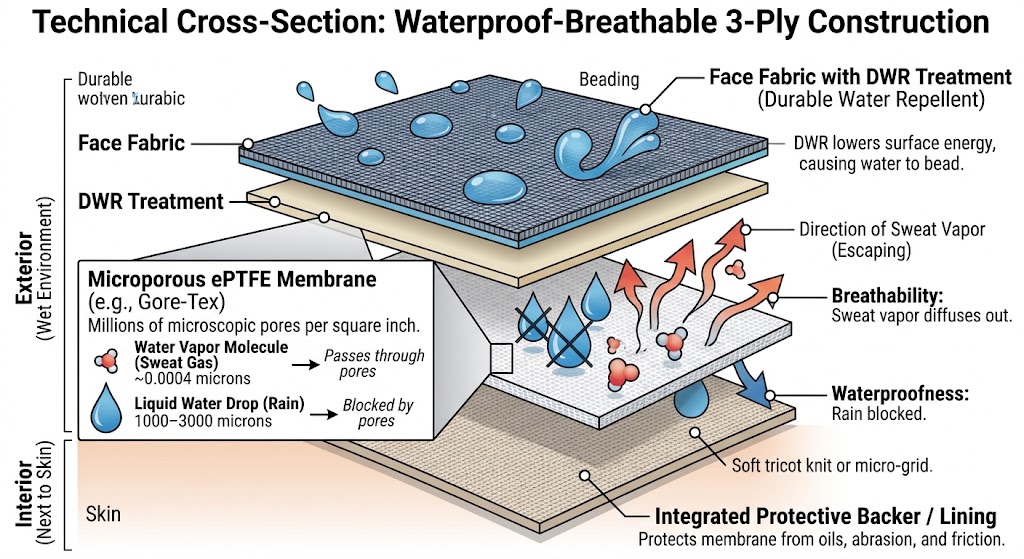
A waterproof-breathable membrane or coating cannot function in isolation. A technical shell garment is typically constructed as a multi-layer composite:
Face Fabric: A durable outer textile (usually woven nylon or polyester) that provides abrasion resistance, structural strength, and tear resistance.
DWR (Durable Water Repellent) Treatment: A chemical treatment applied to the exterior face fabric. The DWR lowers the surface energy of the textile, causing water to bead up and roll off rather than wetting out. If a face fabric "wets out" (soaks up water), it blocks breathability by sealing the pores or cooling the membrane, creating a barrier that prevents sweat vapor from escaping.
The Membrane/Coating: The core breathable barrier sandwiched inside or applied to the interior.
Backer / Lining: The innermost layer protecting the membrane from body oils, abrasion, and friction.
Laminates vs. Coatings
When manufacturers construct high-performance technical shells, they choose between two primary methods for applying the waterproof-breathable technology: laminates or coatings.
Coatings
A coating is a liquid polymer (typically polyurethane) that is directly painted, sprayed, or printed onto the interior surface of the face fabric in a fluid state, then cured in an oven.
How it works: The liquid polymer fills the microscopic gaps in the weave and forms a thin, continuous skin bonded to the fabric.
- Pros:
- Cost-Effective:
- The manufacturing process is faster and cheaper, making coated jackets (such as entry-level rain shells) significantly more affordable.
- Lightweight and Packable:
- Without extra bonding adhesives or heavy interior liners, coated garments can be featherlight and compress into tiny packing volumes.
- Flexible:
- The direct application allows the fabric to drape softly.
- Cons:
- Lower Durability:
- Because the protective layer is exposed directly on the interior, body oils, friction, and abrasion can wear down or flake the coating over time, leading to delamination or loss of waterproofness.
- Lower Performance Ceiling:
- Traditional coatings generally offer lower hydrostatic head (waterproofing) and lower Moisture Vapor Transmission Rate (MVTR) ratings compared to high-end laminates.
- Clammy Feel:
- Without a proper inner lining or printed protective dot matrix, bare coatings can feel sticky or clammy against bare skin when sweating heavily.
(Note: Advanced modern coatings, such as early iterations of brands like eVent's direct-venting technologies or high-end polyurethane formulations, bridge this gap by creating microporous matrices directly on the fabric, but they remain distinct from structural laminates.)
Laminates
A laminate involves creating a solid, pre-formed membrane sheet (such as ePTFE or advanced polyurethane films) and using specialized lamination adhesives or heat-press machinery to bond it permanently to the face fabric (and often an inner backer fabric).
How it works: The membrane is engineered independently to precise micro-tolerances before being fused into a textile sandwich.
- Pros:
- Superior Longevity:
- Laminates are structurally robust and protected by inner linings or backer fabrics, making them exceptionally durable for multi-year expeditions, heavy pack use, and rugged alpine conditions.
- Higher Performance Metrics:
- Laminates consistently achieve extreme waterproof ratings (often exceeding 20,000mm to 30,000mm hydrostatic head) while maintaining high breathability.
- Comfort:
- Paired with tricot knits or woven inner backers, laminates manage internal condensation more effectively and feel comfortable against the skin.
- Cons:
- Higher Cost:
- The complex manufacturing process—requiring precision bonding of multiple distinct layers—makes laminated garments substantially more expensive.
- Stiffness:
- Multi-layer laminate constructions can feel stiffer, noisier ("swishy"), and bulkier than simple coated shells.
3-Ply vs. 2-Ply Construction
Within laminated waterproof-breathable fabrics, construction is classified by how many layers make up the textile sandwich. The two most common configurations are 2-ply and 3-ply.
2-Layer Construction
In a 2-ply fabric, the waterproof-breathable membrane is bonded to a single outer face fabric. Because the delicate inner surface of the membrane is exposed and vulnerable to abrasion, body oils, and dirt, manufacturers must hang a separate, loose lining inside the garment (often a mesh or a lightweight nylon taffeta). Or, to save weight, they forego even the mesh lining reducing both the weight AND longevity in lieu of weight and packability.
Structure: Face Fabric + Membrane + Free-hanging inner mesh/lining.
- Pros:
- Comfort and Drape:
- The loose inner liner keeps the membrane away from the skin and allows the jacket to drape softly and quietly.
- Affordability:
- Cheaper to manufacture than 3-ply bonded composites.
- Everyday Versatility:
- Excellent for urban rain jackets, casual commuting shells, and light hiking jackets where extreme durability under heavy backpacks isn't the primary concern.
- Cons:
- Bulk and Weight:
- The extra hanging liner adds weight and increases pack volume.
- Internal Friction:
- The layers can shift independently, which can create drag when layering over fleeces or base layers.
- Lower Durability:
- Less suited for heavy mountaineering, alpine climbing, or carrying heavy expedition backpacks that compress and stress the fabric layers.
2.5 Layer Construction
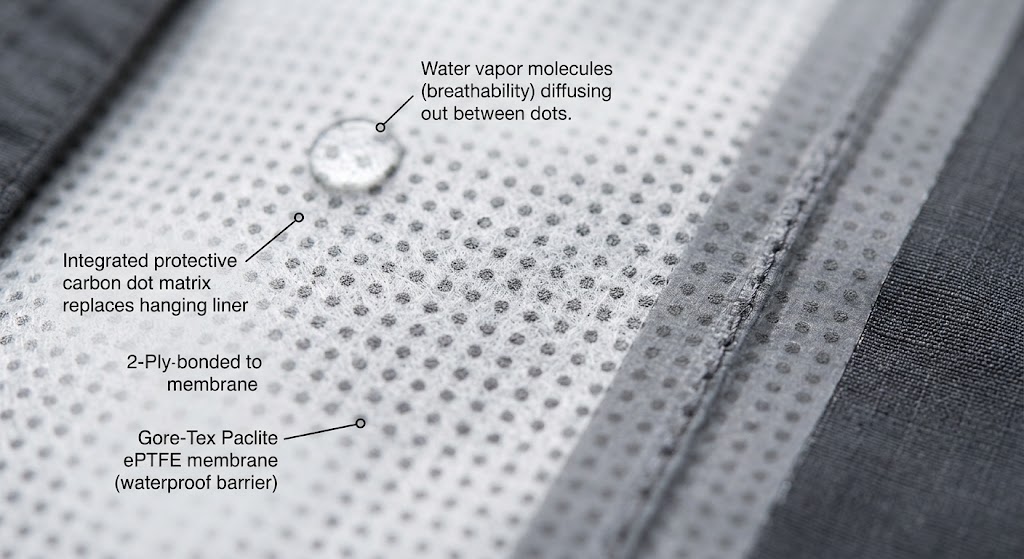
A 2.5-layer waterproof-breathable fabric is a hybrid construction that bridges the gap between lightweight, packable coated jackets and durable, multi-layered laminates.
How It’s Constructed
Like a traditional 3-layer fabric, a 2.5-layer jacket starts with a durable outer face fabric (such as woven nylon or polyester) with a DWR (Durable Water Repellent) treatment on the outside, bonded to a waterproof-breathable membrane on the inside.
However, instead of adding a heavy, full-fabric inner lining (like a 2-ply design) or a bonded fabric backer (like a 3-ply design), manufacturers apply a protective touch-screen-like print, matrix, or ultra-thin ceramic/carbon glaze directly onto the interior surface of the membrane.
Key Characteristics
Extremely Lightweight and Packable: By eliminating a traditional inner fabric layer, 2.5-layer shells are among the lightest and most compressible rain jackets available, often packing down to the size of an apple.
- Affordable: They are generally more budget-friendly to manufacture than complex 3-ply garments.
- The "Clammy" Trade-Off: Because the protective print is very thin, bare skin can sometimes feel a bit sticky or clammy against the interior when you are sweating heavily, as it doesn't manage moisture as comfortably as a soft tricot knit backer.
- Durability: While significantly more durable than a basic, unprotected interior coating, a 2.5-layer print can eventually wear down over time in high-friction areas compared to the heavy-duty protection of a true 3-ply inner backer.
3-Ply Construction
In a 3-ply fabric, all three components—the outer face fabric, the waterproof-breathable membrane, and an inner protective backer—are laminated together into a single, cohesive, unified fabric sheet. There is no loose hanging liner; the interior is a single fabric face.
Structure: Face Fabric + Membrane + Integrated Protective Backer (knit, tricot, or micro-grid).
- Pros:
- Maximum Durability:
- The membrane is safely sandwiched and protected on both sides, making 3-ply shells virtually indestructible against rocks, ice, and heavy pack straps.
- High Strength-to-Weight Ratio:
- Eliminating the hanging liner reduces dead weight, resulting in a streamlined, high-performance garment.
- No Clamminess:
- The integrated inner backer (such as a soft tricot knit or carbon-infused grid) actively moves moisture away from the skin toward the membrane while preventing the cold, sticky feeling of bare membranes.
- Professional Performance:
- The gold standard for technical mountaineering, ski touring, severe weather backpacking, and professional outdoor guides.
- Cons:
- Stiffer Feel:
- 3-ply fabrics tend to be stiffer, less pliable, and noisier than 2-ply alternatives.
- Higher Price Point:
- Premium materials and complex bonding processes make 3-ply garments the most expensive category of rainwear.
Summary
- 2-Ply Construction: Features an outer face fabric and a waterproof membrane, protected by a separate, loose hanging mesh or fabric liner on the inside.
- Best Use:
- Everyday urban commuting, casual walking, and light hiking where extreme durability under heavy backpacks isn't required.
- 2.5-Layer Construction: Combines the face fabric and membrane, but replaces a traditional inner liner with an ultra-thin protective ceramic, carbon, or print matrix applied directly to the membrane. This makes the garment extremely lightweight and packable.
- Best Use:
- Fast-and-light pursuits like trail running, emergency rain shells, and ultralight backpacking where low weight and high packability are top priorities.
- 3-Ply Construction: Fuses the face fabric, membrane, and an integrated protective backer (such as a soft tricot knit or micro-grid) into a single, unified, highly durable fabric sheet.
- Best Use:
- Severe weather mountaineering, technical alpine climbing, ski touring, and rugged multi-day backpacking with heavy pack loads.
Gallery